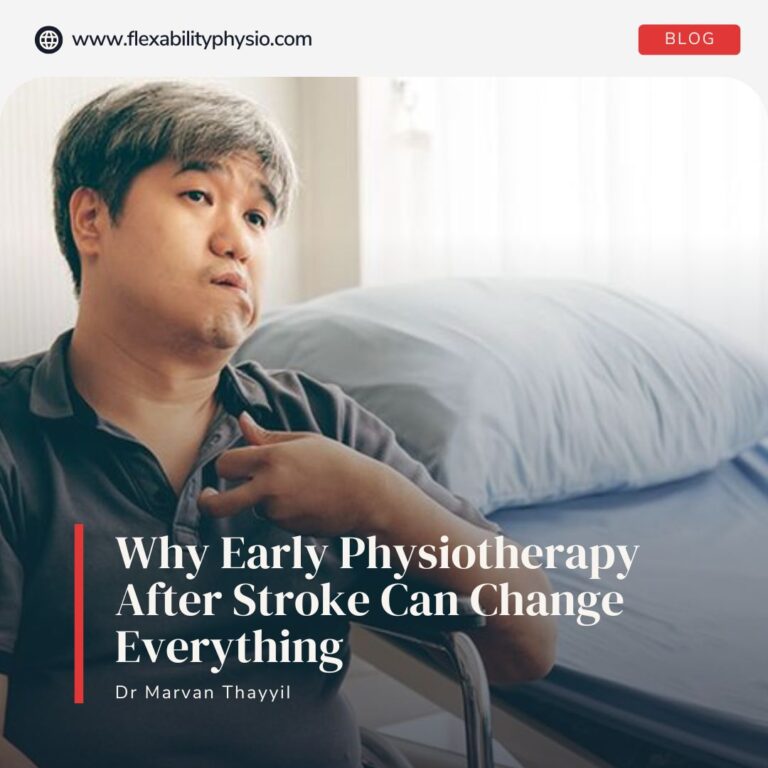
A stroke doesn’t just affect the brain. It changes how a person moves, thinks, and lives — often within minutes. What happens in the hours and days that follow is just as critical as the emergency care received in those first moments. And one factor consistently makes the biggest difference in long-term recovery: how early physiotherapy begins.
What Happens to the Body After a Stroke?
A stroke disrupts blood flow to parts of the brain, affecting how the brain communicates with the rest of the body. The consequences can be immediate and severe — weakness or paralysis on one side of the body, loss of balance and coordination, difficulty walking or standing, and reduced control over even the most basic movements.
But here is the key point that most people miss: the body doesn’t forget movement. What changes is the brain’s ability to control it efficiently. That distinction matters enormously, because it means recovery is not only possible — it is achievable, provided you act early.
The Critical Window: Why Timing Matters
The first few weeks after a stroke are not simply a period of rest and waiting. They represent a window of opportunity that, once closed, cannot be fully reopened.
During this phase, the brain demonstrates a significantly heightened ability to adapt and reorganize itself — a process known as neuroplasticity. Healthy regions of the brain can begin to take over functions lost to damaged areas. New neural connections can form. Movement patterns that were disrupted can be relearned at a far faster rate than at any later stage of recovery.
This window does not stay open indefinitely. Every day of delay reduces both the speed and the extent to which recovery is possible.
What Early Physiotherapy Actually Does
Early physiotherapy is not simply about getting a patient moving. It is a structured, clinically guided process designed to reconnect brain and muscle function, restore fundamental movement patterns, and prevent the secondary complications — stiffness, muscle tightness, joint contractures — that make recovery significantly harder down the line.
Crucially, early intervention prevents the body from adapting to compensatory or incorrect movement patterns. Once those patterns become ingrained, correcting them requires far more time, effort, and resources than addressing them from the outset.
The Real Cost of Waiting
Many families operate under a well-intentioned but costly assumption: let the patient rest first, and start therapy once they’re stronger. In stroke rehabilitation, this is one of the most consequential decisions a family can make — and not in the right direction.
Delaying physiotherapy can lead to progressive muscle stiffness, loss of joint mobility, the development of poor walking mechanics, and a slower or incomplete overall recovery. The neurological principle is straightforward: what you do not use, you lose — and this is especially true in the weeks immediately following a stroke.
A Movement-Based Approach to Rehabilitation
Effective stroke rehabilitation demands more than passive treatment. It requires active, purposeful, and progressive engagement with movement.
The most evidence-supported approaches focus on task-based rehabilitation — relearning real-life actions such as walking, standing, reaching, and transferring — rather than isolated exercises performed in a clinical vacuum. Movement is introduced with purpose, progressed according to individual ability, and always oriented toward functional independence.
This approach works because it mirrors the way the brain actually relearns: through repetition, context, and meaningful activity.
Recovery Is Built Step by Step
Stroke rehabilitation follows a progression that cannot be rushed, but equally cannot afford to be delayed. Recovery typically moves through several distinct stages — regaining basic movement control, improving balance and postural stability, relearning walking and coordination, and progressively building strength and independence.
The earlier this process begins, the smoother the transitions between stages and the greater the functional outcomes at each point.
When Should Physiotherapy Begin?
In most cases, physiotherapy can begin within 24 to 48 hours of medical stabilization, under professional supervision and with appropriate clinical clearance. Waiting weeks or months is not a cautious approach — it is a missed opportunity that carries very real long-term consequences.
The Bottom Line
Stroke recovery is not only about survival. It is about how fully a person reclaims their life — their mobility, their independence, and their identity. That outcome depends heavily on one decision made early in the process.
Starting physiotherapy early is not one option among many. In stroke rehabilitation, time is function, delay is limitation, and early action is the foundation of meaningful recov