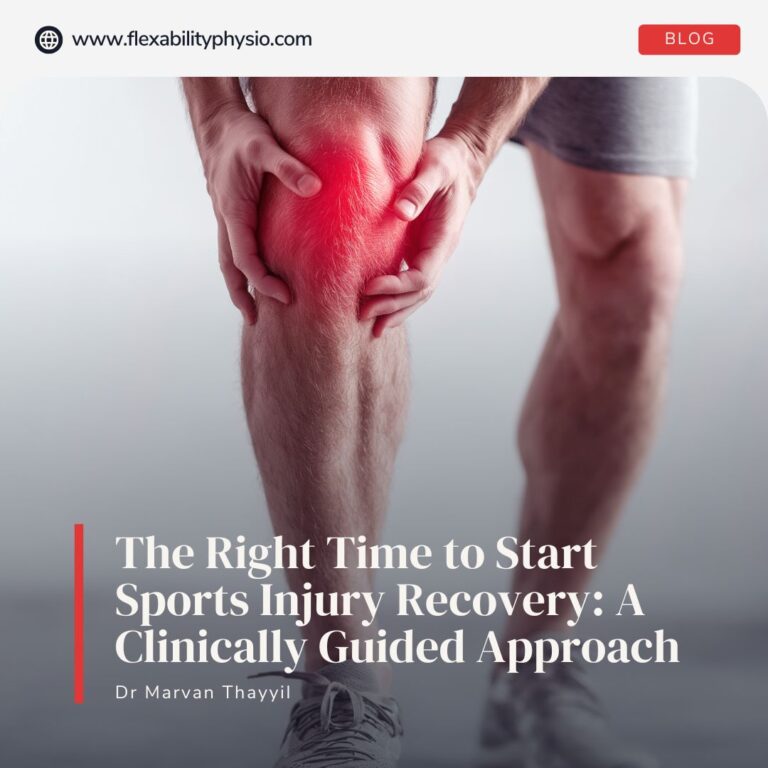
Sports injuries are an unavoidable reality for athletes at every level — from recreational participants to elite competitors. Yet the way an injury is managed in its earliest stages can determine not only how quickly an athlete returns to activity, but the quality and durability of that return.
One of the most frequently asked questions in sports medicine and physiotherapy practice is:
“When is the right time to begin recovery after an injury?”
The clinical answer is both simple and nuanced: recovery should begin immediately — but it must follow a structured, phase-appropriate approach guided by sound clinical principles. The instinct to either push through pain or to rest indefinitely are both equally harmful. What the evidence consistently supports is early, graduated, professionally supervised intervention.
This article outlines what that process looks like, why timing matters, and how athletes can avoid the common pitfalls that turn manageable injuries into chronic conditions.
Understanding the Distinction Between Injury and Recovery
To appreciate why timely recovery matters, it helps to understand what actually happens inside the body when an injury occurs.
At the moment of injury — whether it is a muscle tear, ligament sprain, tendon strain, or bone stress — the body initiates an immediate inflammatory response. Blood flow increases to the affected area, immune cells are mobilised, and a complex cascade of chemical signals begins the process of tissue repair. This response, while painful and limiting, is entirely necessary. Inflammation is not the enemy; uncontrolled or prolonged inflammation is.
Recovery, therefore, is not simply the absence of injury. It is the active management of this biological process — guiding the body through its natural healing stages while simultaneously preventing the secondary consequences of inactivity, such as muscle atrophy, joint stiffness, proprioceptive deficits, and psychological deconditioning.
True, clinically sound recovery encompasses:
- Controlled tissue healing — protecting the injured structure while allowing the repair process to proceed without re-aggravation
- Systematic restoration of mobility — preventing the scar tissue and joint stiffness that develop when movement is avoided for too long
- Progressive strength rebuilding — addressing the muscular weakness that rapidly follows any significant injury
- Neuromuscular re-education — restoring the coordination, balance, and movement patterns that are disrupted by injury
- A safe, criteria-based return to activity — ensuring that the athlete is genuinely ready to return, not merely pain-free
This final point deserves particular emphasis. Pain relief alone is not an indicator of complete recovery. Tissue healing and symptomatic resolution do not occur simultaneously. An athlete may feel ready to return weeks before the underlying tissue has regained sufficient strength and resilience to withstand the demands of sport. Returning at this stage is one of the most common causes of re-injury.
The Four Phases of Sports Injury Recovery
Recovery is not a single event — it is a sequential process that unfolds across several distinct biological and functional phases. Understanding each phase, and what is clinically appropriate within it, is essential to optimising outcomes.
Phase 1 — Acute Phase (First 48–72 Hours)
The acute phase represents the body’s immediate and vigorous response to tissue damage. During this window, the priority is not rehabilitation — it is protection and inflammation management.
What is happening biologically: At the cellular level, damaged blood vessels release platelets that form a clot to prevent further bleeding. White blood cells flood the area to clear debris and begin the repair process. Pro-inflammatory cytokines signal pain and swelling, which serve the dual purpose of alerting the individual to the injury and encouraging rest of the affected area. This is a necessary and beneficial process, but one that benefits from clinical support.
Clinical presentation:
- Acute, often sharp or throbbing pain at the site of injury
- Visible or palpable swelling due to increased local fluid
- Skin warmth and, in some cases, bruising as blood disperses through tissue planes
- Significant restriction of movement, both due to pain and mechanical swelling
Clinical priorities and management:
The internationally recognised POLICE framework — Protection, Optimal Loading, Ice, Compression, and Elevation — has largely replaced the older RICE protocol in modern sports medicine practice and offers a more nuanced approach:
- Protection: Avoid movements and activities that stress the injured structure. Use braces, taping, or assistive devices where appropriate to prevent further damage.
- Optimal Loading: Complete immobilisation is rarely indicated. Even in the acute phase, gentle, pain-free movement can reduce swelling, stimulate early tissue organisation, and prevent unnecessary deconditioning.
- Ice: Applied for 15–20 minutes at a time, ice helps to reduce local pain and limit excessive swelling. It does not accelerate healing, but it improves comfort and function during this phase.
- Compression: External compression reduces swelling accumulation and provides proprioceptive feedback to the injured area.
- Elevation: Positioning the injured limb above heart level reduces hydrostatic pressure and assists in fluid drainage.
It is also critical during this phase to obtain an accurate diagnosis. Many athletes underestimate the severity of their injury in the acute phase and delay seeking assessment. Early imaging and clinical evaluation — where appropriate — ensure that serious structural damage such as fractures, complete ligament ruptures, or compartment syndrome is not missed.
Phase 2 — Early Recovery Phase (Days 3–7)
As the acute inflammatory response begins to subside, the body enters the early proliferative phase of healing. New tissue begins to form at the injury site, and the clinical focus shifts from protection to controlled, progressive movement.
What is happening biologically: Fibroblasts — cells responsible for producing collagen — migrate to the injury site and begin laying down new connective tissue. At this stage, the collagen fibres are disorganised and fragile. Gentle mechanical loading during this phase actually helps to orient the new fibres along lines of functional stress, resulting in stronger, better-organised scar tissue. Without this stimulus, the repair tissue is weaker and more prone to re-injury.
Clinical presentation:
- Measurable reduction in pain levels, though discomfort with movement remains
- Increasing stiffness, particularly after periods of rest or in the morning
- Limited but gradually improving range of motion
- Persistent but reducing swelling
Clinical priorities and management:
This is the phase in which physiotherapy intervention becomes both appropriate and essential.
- Guided range-of-motion exercises: Gentle, clinician-prescribed movements help to mobilise the healing tissue, restore joint lubrication, and prevent the formation of restrictive adhesions.
- Manual therapy: Soft tissue techniques and joint mobilisation, where appropriate, can accelerate mobility recovery and reduce pain.
- Hydrotherapy: For lower limb injuries in particular, pool-based exercise allows early loading with reduced gravitational stress on the healing tissue.
- Patient education: Understanding the healing process, activity modifications, and what to expect over the coming weeks is a critical but often undervalued component of recovery. Athletes who understand their injury are more adherent to rehabilitation protocols and have better outcomes.
Commencing formal physiotherapy during this phase — rather than waiting for symptoms to fully resolve — is one of the most impactful decisions an injured athlete can make.
Phase 3 — Rehabilitation and Strengthening Phase (Weeks 1–3 and Beyond)
By this stage, the acute injury has stabilised and the healing tissue is progressively maturing. However, the functional consequences of the injury — particularly muscular weakness, reduced stability, and altered movement mechanics — now become the dominant clinical concern.
What is happening biologically: The remodelling phase of tissue healing is underway. Collagen continues to mature and reorganise, gradually increasing in tensile strength over weeks to months. However, the repaired tissue does not immediately replicate the mechanical properties of the original. Progressive loading is necessary to drive this remodelling process and restore full functional capacity.
Clinical presentation:
- Pain is largely resolved or minimal with everyday activity
- Marked muscular weakness and reduced power, particularly in muscles that were either directly injured or reflexively inhibited during the acute phase
- Compromised joint stability and proprioception
- Potential for compensatory movement patterns that may predispose adjacent structures to injury
Clinical priorities and management:
This phase demands a comprehensive, structured rehabilitation programme tailored to the specific injury, the athlete’s sport, and their individual functional goals.
- Progressive resistance training: Loading the healing tissue in a controlled, graduated manner drives tissue remodelling and prevents the long-term weakness that follows injury. This begins with low-load, high-repetition exercises and progresses systematically to heavier, more sport-relevant loading.
- Neuromuscular and proprioceptive training: Balance boards, perturbation training, and single-leg exercises restore the sensorimotor function of the injured area — a component of recovery that is frequently overlooked but critically important for re-injury prevention.
- Cardiovascular conditioning: Maintaining aerobic fitness through non-weight-bearing or low-impact alternatives — such as cycling, swimming, or upper body conditioning — prevents the significant deconditioning that occurs during extended rehabilitation periods.
- Biomechanical assessment: Identifying and addressing dysfunctional movement patterns — such as altered gait mechanics, asymmetrical loading, or compensatory strategies — is essential to ensuring that the athlete returns to sport with a reduced injury risk profile.
Phase 4 — Return-to-Activity Phase
The return-to-sport phase is arguably the most consequential phase of the entire recovery process, and yet it is the one most frequently mismanaged. Returning to full training or competition on the basis of symptom resolution alone, without objective functional testing, is a significant clinical error.
What is happening biologically: While the injury site may feel normal and pain-free, tissue remodelling continues for months — and in some cases, years — after the initial injury. The mechanical properties of the repaired tissue continue to improve with progressive loading, but they may not yet match those of uninjured tissue. This biological reality underscores the importance of evidence-based return-to-sport criteria rather than subjective symptom reporting.
Clinical presentation:
- Functional movement patterns largely or fully restored
- Strength levels approaching symmetry with the uninjured side
- Confidence in the injured area during activity, though some residual psychological apprehension is common
Clinical priorities and management:
- Objective return-to-sport testing: Validated functional assessments — such as single-leg hop tests, isokinetic strength testing, and sport-specific movement screens — provide objective data on readiness and remove the guesswork from return-to-sport decisions.
- Sport-specific rehabilitation: The final stages of rehabilitation should mirror the demands of the athlete’s sport as closely as possible. Running athletes should be performing running-based drills; court sport athletes should be progressing through change-of-direction and reactive agility work.
- Graduated exposure: A structured return-to-training programme that incrementally increases load, intensity, and complexity — rather than an abrupt return to full training — significantly reduces the risk of re-injury during this vulnerable period.
- Psychological readiness: Fear of re-injury is a well-documented barrier to successful return to sport. Addressing psychological readiness as part of the return-to-sport process — through confidence-building exposure and, where appropriate, psychological support — is an increasingly recognised component of comprehensive rehabilitation.
Why Timing Is Critical: The Evidence Base
The timing of recovery initiation is not merely a practical consideration — it has well-established implications for clinical outcomes. The evidence consistently demonstrates that early, guided intervention produces superior results across every relevant metric.
Specifically, early and professionally supervised recovery has been shown to:
- Accelerate the natural healing cascade by providing the mechanical stimuli necessary for optimal tissue repair and remodelling
- Significantly reduce total recovery duration compared to periods of prolonged rest or delayed physiotherapy initiation
- Prevent the development of chronic pain by addressing the neurological sensitisation and structural maladaptation that can occur when acute injuries are inadequately managed
- Reduce the risk of recurrent injury by systematically restoring strength, proprioception, and movement quality before return to sport
- Preserve cardiovascular and musculoskeletal fitness by maintaining conditioning through appropriate exercise modifications throughout the recovery period
Conversely, delayed intervention — even by a matter of days in certain injury types — has been associated with increased scar tissue formation, greater strength deficits, and longer overall recovery timelines.
Common Mistakes That Impede Recovery
Despite the availability of evidence-based guidance, a number of highly prevalent mistakes continue to prolong recovery for many athletes. Awareness of these errors is the first step to avoiding them.
1. Ignoring or minimising early symptoms Training through pain, dismissing swelling as insignificant, or convincing oneself that an injury will “sort itself out” frequently converts a manageable acute injury into a chronic, complex condition. Early assessment is always worthwhile.
2. Premature return to activity The desire to return to sport as quickly as possible is understandable, but returning before adequate tissue healing and functional restoration have occurred dramatically increases re-injury risk. In some injury types, re-injury at this stage can be significantly more severe than the original.
3. Prolonged complete rest without rehabilitation While rest is appropriate in the acute phase, extended immobilisation without graduated rehabilitation leads to rapid muscle atrophy, joint stiffness, cartilage deconditioning, and neuromuscular inhibition. The research is unequivocal: early, controlled movement produces better outcomes than prolonged rest.
4. Reliance on passive treatments alone Modalities such as electrotherapy, massage, and acupuncture have a role in pain management, but passive treatments alone will not restore strength, proprioception, or functional movement. Active rehabilitation is the cornerstone of effective recovery.
5. Self-management without professional guidance Following generic advice from non-clinical sources — whether online, from peers, or based on previous injury experience — frequently leads to inappropriate rehabilitation, missed diagnoses, and avoidable complications. Every significant injury deserves a professional assessment.
When to Seek Professional Assessment
Athletes should seek physiotherapy assessment without delay if any of the following are present:
- Pain that persists beyond 72 hours or worsens rather than gradually improving
- Swelling that does not respond to standard first-aid measures within 48–72 hours
- Significant restriction of movement or inability to bear weight
- Any sensation of joint instability, giving way, or locking
- Audible or palpable sounds at the time of injury (clicking, popping, or tearing)
- Numbness, tingling, or altered sensation around the injury site
- Recurring injury to the same anatomical site
Early clinical assessment enables accurate diagnosis, appropriate classification of injury severity, and the development of a structured, individualised recovery plan from the outset — significantly improving the probability of a full and timely recovery.
The Role of Physiotherapy in Sports Injury Recovery
Physiotherapy is not simply a treatment modality reserved for severe injuries. It is a comprehensive, evidence-based recovery system that encompasses assessment, diagnosis, rehabilitation, and performance restoration.
A well-designed physiotherapy programme provides:
- Accurate clinical diagnosis and, where necessary, co-ordination with sports medicine physicians and imaging services to characterise the injury fully
- Individualised rehabilitation planning based on the athlete’s injury profile, sport-specific demands, and personal performance goals
- Systematic restoration of mobility, flexibility, and tissue extensibility through progressive manual therapy and exercise prescription
- Evidence-based strength and conditioning protocols that drive tissue remodelling and restore functional capacity
- Movement analysis and correction to identify and address the biomechanical factors that may have contributed to the original injury and that increase re-injury risk
- Education and self-management strategies that empower the athlete to actively participate in and understand their recovery
- Objective return-to-sport clearance, based on validated functional testing rather than symptom-based judgement alone
The value of physiotherapy lies not only in what it treats, but in what it prevents. Athletes who complete comprehensive physiotherapy programmes demonstrate lower rates of re-injury, better long-term functional outcomes, and a faster overall trajectory back to their pre-injury performance levels.
Conclusion
The right time to begin sports injury recovery is immediately — but within a structured, phased, and clinically guided framework that respects both the biology of tissue healing and the individual needs of the athlete.
Recovery is not a passive process of waiting for pain to subside. It is a deliberate, active commitment to guiding the body through each phase of healing in the most efficient and evidence-informed way possible. Every day of delayed or poorly managed recovery is a day of unnecessary setback.
With early assessment, appropriate clinical management, and a structured rehabilitation programme, the vast majority of sports injuries — regardless of severity — can be resolved fully, with a complete return to performance and a significantly reduced risk of recurrence.
If you have sustained a sports injury, the most important step you can take today is to seek a professional assessment. The earlier that process begins, the better your outcome will be.